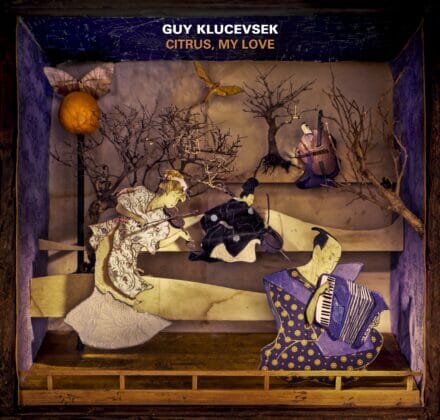




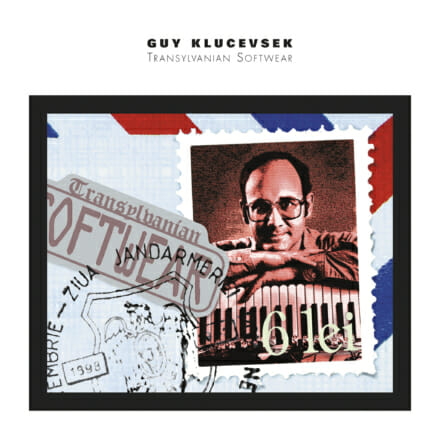
Guy Klucevsek consistently offers some of the most listenable new music heard today. Kyle Gann comments that “Klucevsek is one of those natural-born musicians incapable of turning out an unmusical phrase,” noting the “graceful musicianship that informs his every gesture.” So it’s not surprising that Stereo Review awarded this CD a “Recording of Special Merit,” calling it “a funny and original album by an unusual artist.”
“One of only two or three important accordion composers” (The New Yorker), Guy Klucevsek has also commissioned a wide variety of composers, including Fred Frith, Aaron Jay Kernis, Alvin Lucier, Christian Marclay, Somei Satoh, Lois V Vierk, and John Zorn. He has also performed and/or recorded with Laurie Anderson, Anthony Braxton, Bill Frisell, and the Kronos Quartet.
Klucevsek’s “original, sweetly postminimal vocabulary” often draws on world folk music. The title piece on the CD is based on Hasidic wedding music, while the lovely “Viavy Rose” Variations is based on traditional melodies from Madagascar, and the moving Perusal is inspired by Andean pan-pipe music. The rhythmically infectious Three Microids is a tribute to Bela Bartok, and the heartfelt Bandoneons, Basil and Bay Leaves was written in memory of Astor Piazzolla. Other pieces include John Zorn’s zigzagging Road Runner, William Duckworth’s smoothly exotic Slow Dancing in Yugoslavia, and Fred Frith’s oddly humorous The Disinformation Polka.
Here are excerpted comments about these pieces from Klucevsek:
“To the extent that the compositions on this album have a unifying theme, it is that they are based on, or influenced by, popular and folk music from all over the world. Transylvanian Softwear is based on Hasidic wedding music. The ‘Viavy Rose’ Variations are based on two traditional accordion melodies from Madagascar.”
“The Road Runner-and-Coyote cartoon scores of Carl Stalling inspired Road Runner, which refers to just about every piece of music ever written. I originally recorded Road Runner in 1986 for my cassette-only release ‘Blue Window’ (Zoar, out-of-print), and re-released that recording on my CRI CD ‘Manhattan Cascade.’ Interestingly, the first time I played Road Runner was the first recording. John Zorn created the piece for, and we approached it as, a ‘studio’ recording. For the first recording I plugged my accordion directly into the mixing board, with no room ambiance, and using discrete left/right separation of the hands. We recorded each five- to fifteen-second segment separately, then bounced the tracks, to preserve the feeling of recording in real time and to avoid editing. Since 1986, I have probably performed Road Runner more than 200 times; I wanted to do a real-time, ‘live’ acoustic performance for this recording.”
“Perusal exploits the sounds heard in Andean pan-pipe music. It appeared on my ‘Flying Vegetables of the Apocalypse’ CD in its original version for two violins, cello, and accordion, but I have most often performed it as a solo.”
“I wrote Bandoneons, Basil and Bay Leaves as a tribute to Astor Piazzolla, tango composer, arranger, bandoneon player extraordinaire, and one of my favorite musicians. Bela Bartók’s progressive piano studies Mikrokosmos feature experimental techniques and folk elements, most notably the unusual rhythmic meters and melodic scales found in the Hungarian, Romanian, and Bulgarian folk music he loved.”
“The Three Microids are my tribute to Bartók. My Right Foot, on the Other Hand is a study in polymeter. The right hand is in 3/4 time, while the left is usually in 5/4 or 10/8. Eleven Large Lobsters Loose in the Lobby is in 11/8, and is a percussion-only piece. Bustin’ Broncos in the Balkans is in 13/8.”
“Listen carefully to the eight sections that make up Slow Dancing in Yugoslavia, and you may hear what the evergreen ballad It’s All in the Game (‘Many a tear has to fall…’) would sound like if the notes were rearranged to an Eastern European modal scale and the time changed to an Eastern meter.”
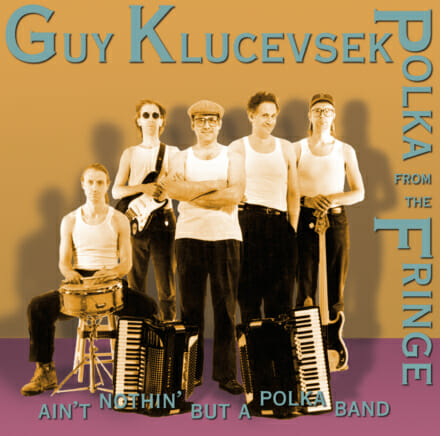
“The Disinformation Polka was orignally recorded by my group ‘Ain’t Nothin’ But a Polka Band’ on Volume Two of Polka from the Fringe. However, Fred Frith has always loved the solo version. He says it is zanier and more manic, so I promised him I would record the solo version at my earliest opportunity. I asked Fred whether the title was political. He replied ‘No, it just reflects the fact that I have no idea what a polka is.’ ”
Guy Klucevsek
Guy Klucevsek has created a unique repertoire for accordion through his own composing and by commissioning over 50 works from leading composers. Solo performances include the Adelaide Festivals in Australia, the Berlin Jazz Festival, New Music America, Serious Fun! at Lincoln Center, Bang on a Can, and the children’s television show Mr. Rogers’ Neighborhood. He was an original member of Dave Douglas’s band, Charms of the Night Sky, and in 1996 he formed The Accordion Tribe, an international line-up of composer/accordionists who have released two recordings and are the subjects of the Stefan Schwietert documentary film, Accordion Tribe: Music Travels. You can also hear him on John Williams’s scores for the Steven Spielberg films The Terminal and Munich.