




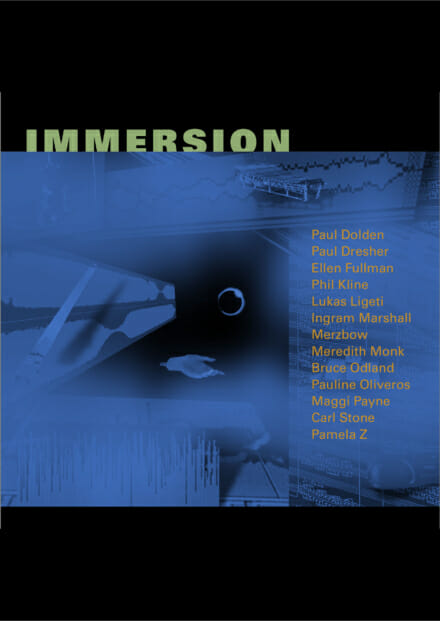
Immersion is now recognized as a groundbreaking recording that let listeners experience new music in high-resolution surround sound for the first time in history. All the music was commissioned by Starkland exclusively for this surround sound release.
Immersion plays on regular DVD players, as well as audiophile DVD-Audio units.
“I think surround sound offers a wonderful medium for new music. Commissioning a wide variety of today’s composers to create music specifically for high-resolution surround sound seemed a terrific way to help launch the surround sound era,” says Thomas Steenland, Starkland’s President.
All the composers were excited about high-resolution surround sound. Meredith Monk comments that “in many of my pieces, I have worked with making a space ring or resound by placing singers in a ‘surround sound’ spatial relationship to the audience. Now I really appreciate that there is a playback medium which allows that visceral, rich perceptual experience to happen at home.”
Tomlinson Holman, one of the world’s leading surround sound authorities, states that “this fascinating disc” is among the first “to show composers stretching the boundaries of recorded sound by exploring the new possibilities inherent in DVD-Audio.”
All the music on the Immersion DVD involves you in ways never before possible.
In the opening piece Live/Work, Pamela Z gives you a virtual surround tour of her studio with a precision that you have never previously heard. Z is an audio artist who works primarily with voice, live electronic processing, and sampling technology. In performance, she creates layered works that combine operatic bel canto and experimental vocal techniques with a battery of digital delays, found percussion objects, spoken word, and sampled concrete sounds.
Pamela Z on Live/Work
“My idea for this surround sound work for Starkland was to create a kind of aural map of my surroundings. I stood in the middle of my studio and turning slowly clockwise, cataloged objects in my field of vision. Standing in that same spot, I then made a recording of myself reading the list (using the sound of the room rather than my isolation booth.) In ProTools, I mapped these text regions to match the placement of the objects in the room by organizing them in tracks representing the front, right, back, and left walls as four stereo fields. I then combined these tracks with additional vocal samples which I also recorded in the space. All sound sources in the piece are my own voice.”
Bruce Odland’s Tank places you in a huge water tank (located in Rangely, CO), where you hear Ron Miles’ trumpet reverberating for up to 40 seconds, with an authentic reality simply not possible in conventional stereo. Odland is known for his psychoacoustic sound designs for theatre and for his cutting-edge, large-scale multimedia installations in public spaces, and has collaborated with many of America’s leading theatre directors, including Peter Sellars, JoAnne Akalaitis, and Andre Gregory.
Bruce Odland on Tank
“For the live trumpet recording used in Tank, I suspended four mics at intervals around the tank and recorded to two DAT players. Later the trumpet sound was reassembled and edited in a ProTools session, slipped together spatially, and surrounded with a circle of monophonic drums. The drums, from the Field Museum collections, were played by Chicago area musicians (including Leddie Garcia of Poi Dog Pondering), recorded through hand-built mic preamps, direct to digital audio tape. I then played the drum samples on a Drum Kat and recorded them as sequences. The sequences and harddisk recordings were then assembled in ProTools and mixed to a 6-channel virtual mix before transfer to ADAT.”
Maggi Payne’s White Turbulence 2000 begins by putting you in the center of a dramatic circling pan of a convolved thunderous airplane, and then adds highly processed water-based sounds. Having created quadraphonic pieces during 1973-1985, she now comments about returning to surround sound: “To be able to once again have more spatial control of the sound environment is exciting. To enter this more complete world allows one to more fully sculpt the space/experience dynamically over time.”
Maggi Payne on White Turbulence 2000
“The original source tracks for White Turbulence 2000 were edited, equalized, phase vocoded, time-stretched/compressed, etc., then sampled via optical link. I graphed the spatial paths and pitch content (where applicable) for each of the sections, played them on the sampler while recording into a MIDI sequencer program, made adjustments in the sequencer, then re-recorded back to my digital audio workstation. After further refinements, I then put it all together in the final Edit Decision List, fine tuning the exact placement/timing of the sections in relationship to one another. Ideally listeners will be positioned in the center of four matched speakers for this piece. The photomicrographic slides shown during the DVD playback are images of crystallization of various chemical solutions which I photographed using polarized light.”
“One of the best composers working in the country today” (Village Voice), Carl Stone shifts hyper-speed hallucinatory barrages from speaker to speaker in Luong Hai Ky Mi Gia. “The opportunity to make a piece using the medium of surround sound for Starkland’s DVD has allowed me to expand on some of the quadraphonic techniques that I often use in live performance,” says Stone.
Carl Stone on Luong Hai Ky Mi Gia
“The stereo outputs of my Macintosh computer, running Max/MSP software from Cycling 74, were digitized and then transferred to a ProTools Mix24 editing system (hosted on a Macintosh 350 MHz G3 with 198 MB RAM), where they were mixed and spatialized using a Panasonic DA-7 mixer. Final multi-channel output was to ADAT.”
Phil Kline’s haunting piece, The Housatonic at Henry Street, is a “vision of enfolded time flowing through a place on Manhattan’s Lower East Side, where successive waves of migrant humanity have overlapped for centuries. Background and foreground are blurred as street sounds are recorded, then mixed with ‘musical’ material from computer and tape.” The result situates you in “an imaginary surrounding landscape in which past and present hang out together in asynchronous multitonal harmony.” Early in his music career, Kline, with former classmates Jim Jarmusch and Luc Sante, founded the rock band the Del-Byzanteens, and in 1988 he joined the Glenn Branca Ensemble. In 1990 he began producing a body of work using large numbers of boombox cassette machines to create complex phase patterns and sound masses. “A real original” (New York Times), Kline notes that “By nature all of my works are surround sound pieces.”
Phil Kline on The Housatonic at Henry Street
“By nature all of my works are surround sound pieces which when recorded have been reduced to stereo. But as they are also virtual creations, there is no need to present a ‘true’ soundstage, so an audio image can be composed as part of the ‘fiction’ of the piece, much as a director and designer create the geography of an opera or film set. For Starkland’s project, I began by recording the sounds of Henry Street (near the corner of Rutgers) which were then combined with material from midi instruments and dubbed onto cassettes, played back on multiple boomboxes in the street, and rerecorded from a number of perspectives. The boomboxes were not all recorded at once, but divided into small choirs and recorded separately using two mics in an M-S (Mid-Side) configuration. Then all of the elements – pure street sounds, pure midi straight from the computer, and various combinations of the two played on boomboxes – were mixed and configured to evoke the fantasy of a walk along Henry Street, with a slight breeze blowing from the east and the cosmic tide rolling in.”
Ellen Fullman’s work places you in real world/virtual spaces only possible with surround sound. Margaret Tuned the Radio In Between Two Stations is one of two pieces on Immersion that employs composer-created instruments using unusually long strings. Since 1981 she has composed for her Long String Instrument, which uses strings nearly 100 feet long, filling her warehouse studio. Fullman comments that “In creating the surround sound mix, it was thrilling to hear a recording, for the first time, that envelops the listener, mirroring the live experience of my instrument.”
Ellen Fullman on Margaret Tuned the Radio in Between Two Stations
“The installation of the Long String Instrument (LSI) used for this Starkland recording has about 100 strings, suspended at waist height for 96 feet. The strings terminate into acoustic wooden box resonators. The instrument is played by rubbing the strings with rosin-coated fingertips, while walking. Duration of pitch sustain is determined by distance traveled. The performer occupies a pathway between two banks of strings. A C-clamp on each wire is used for tuning, changing the string length much like a capo on a guitar. The instrument is tuned in just intonation, a natural tuning system. The three octave range is centered on middle C. The strings of the bass octave extend the instrument’s full length. The middle and high octaves are suspended from double-sided resonators mounted in the center of the room; strings extending to either wall. The physical scale of the installation and the way that the overtones interact with the space turn the room itself into a giant musical instrument.
“Scott Colburn designed the surround mix. His intention was to create a mix that utilizes movement, creates phantom images, has a front and back side; but is also interesting regardless of the listener’s position in the room.
“I made the recordings direct-to-disk using ProTools and a pair of Brüel & Kjær microphones. The mics were placed close (from 1 to 3 feet) to the resonators. The mid and high range resonators, one on either side of the performer, are played by the left and right hands. These were miked separately. Each track was then individually played back and miked to record the natural reverb of the 1500 sq. ft. concrete space.
“The mix is constructed in three layers. The bass strings were placed in the center channel with the ambience track placed in the phantom center of the surround pair. The next layer is the middle octave strings. The dry stereo pair of the mid strings were placed beyond the front stereo speakers with the ambience slightly beyond the surround pair of speakers. This creates a phantom stereo image between the front and surround speakers, emphasizing the non-directionality of the listening environment.
“The third layer is the only layer that moves. The sound source is a technique called ‘twine.’ A piece of fishnet repair twine, tied around an LSI string, is rubbed between the fingers. This has a fluttering, percussive, mandolin-like quality. A scale was divided between the two resonators, left to right, in chromatic order. Each resonator was miked separately, producing a ‘call and response’ between the left and right channels. The dry sound starts in the surround pair of speakers and the ambience starts in the front pair of speakers. The ambience of the right channel surround is placed in the left front speaker and the left channel surround ambience is placed in the right front speaker. Over the course of the piece, the dry signal starts in the surround pair, moves to the front then returns to the surround pair; as the ambience starts in the front, moves to the surround pair, then returns to the front.”
Lukas Ligeti co-founded the group Beta Foly, perhaps Africa’s only experimental music ensemble combining traditional and electronic instruments. PropellerIsland takes advantage of widely spaced playback speakers to explore his interest in polymetrics. He surrounds you with steel drums, West African balafons, and other percussion in multiple tempos. Every time you listen, the beat elusively shifts and new rhythmic vantage points emerge and recede.
Lukas Ligeti on Propeller Island
“When thinking about a piece for a multiple-speaker environment, an idea that immediately came to my mind was to use long sounds, and to have them travel gradually around the surround system. But I soon abandoned this to do quite the opposite: in Propeller Island, I use almost exclusively short, percussive sounds, which enable me to depict polymetric relationships in ways that a concert environment or a stereo image would not allow.
“I composed Propeller Island using my Akai S-3000 sampler and Cubase sequencing software running on a very old PowerBook. My sound material consists primarily of samples of instruments of three musicians that I have been lucky to work with: the Trinidadian, Miami-based steel pan musician Michael Kernahan (I also use some samples I made of him building pans, hammering them into tune), and the two balafonists Aly Keïta (from Côte d’Ivoire, but building instruments in the Bobo tradition from southern Mali and Burkina Faso) and Kaba Kouyaté, who hails from Guinea and plays music of the Malinke. The two balafons, which sound very different, are contrasted in opposite channels at several points during the piece. These sounds, especially the pans, are detuned in the sampler. Other sampled sounds include those from my Roland drum computer and my Nord synthesizer.
“Melodies using these sampled sounds are often interlocked, creating different resultant melodies in various frequency bands. The front center channel serves as a ‘timekeeping’ channel using various bell patterns, and notes falling between those of the patterns encircle the listener in different timbres and directions. This way, in addition to speed of ‘beats per minute’ or of timbral change, speed of movement within space also becomes a factor that can cause polymetrics when combined with other musical lines moving around at other speeds. This forms a kind of ‘harmony of distribution of meter in space,’ and I hope that it is possible to listen to Propeller Island many times, each time from a different musical vantage point, to discover fresh aspects of spatial meter with every new listen. The key to this is the concept of a relative beat: depending on your musical point of view, the meter can be felt differently. This sensation, important in certain types of Central and East African music (I’m very strongly influenced by traditional musics from all over the world, but especially from Africa, a continent to which I’ve developed strong ties in recent years), can be felt when within a multi-loudspeaker environment in a way that is almost dizzyingly complex, yet remains clear because of the separation of the sound sources.”
Paul Dresher also wrote his postminimalist work, Steel, for a unique instrument, the Quadrachord, which he co-invented and constructed. It has four 14-foot long steel strings, with electric bass pick-ups at both ends. He writes that “both ends of the strings are acoustically ‘active,’ making the Quadrachord’s sound inherently spatial. Because of their length, the strings often vibrate sympathetically, imparting a remarkable reverberant quality. This aspect in particular inspired its use in this surround sound composition for Starkland.” Dresher, “one of the best post-minimalist composers” (Stereo Review), writes for a wide variety of forms (from experimental music theater to orchestral pieces), tours with his Electro-Acoustic Band, and has had his works performed at the New York Philharmonic, BAM’s Next Wave Festival, Minnesota Opera, and five New Music America Festivals.
Paul Dresher on Steel
“I have to admit I was a bit skeptical at first regarding just how interesting developing a piece for surround sound would be given my own musical interests. However, it didn’t take many experiments to quickly reveal both the sensuous nature of the medium and the possibility of organizing the compositional material (particularly rhythmic counterpoint) in ways that exist only in such a spatial form.
“Steel was produced by recording onto DAT both numerous individual sounds produced by various playing techniques on the Quadrachord as well as focused improvisations exploring the range of individual playing techniques on the instrument. This material was then handled in two distinct ways.
“All sound material was input into a Macintosh G3 computer running Digital Performer and Peak, using a Mark of the Unicorn 2408 as the digital I/O. Individual notes or events were edited in Peak (EQ, gain adjustments, looping, etc.) and then downloaded into both Akai S1000 and Kurtzweil K2000 samplers, where programs were created duplicating some of the actual playing techniques. Improvisations were edited and chopped up into individual phrases.
“The composition was assembled in Digital Performer, using both MIDI tracks triggering the samplers and digital audio playback of the reassembled improvisations in Digital Performer. All these sources (eight outputs from Digital Performer and four outputs each from the Akai and Kurtzweil samplers) were mixed through a Yamaha 03D, using its surround sound mixing capabilities.
“Except for the looping of some repeated rhythmic events in the samplers and very slight reverb and EQ on the overall mix, there is NO signal processing used in the generation or mixing of the final recording.”
In her Immersion work, Sayonara Sirenade: 20/21, Pauline Oliveros draws on materials from a 1966 spatially-presented improvisation. “Extracting sounds from the old piece, I used today’s software to create new tracks, adding placement and movement. The new piece reveals the depth of field that was missing since that first studio performance. The flatness of stereo became fullness in surround sound. Spatiality becomes the clarifying parameter in composition.” Oliveros and her work with improvisation, meditation, electronic music, myth, and ritual have been an important influence on American Music for four decades; in 1991 she was awarded a letter of distinction from the American Music Center at New York’s Lincoln Center. John Rockwell has written: “On some level, music, sound consciousness and religion are all one, and she would seem to be very close to that level.”
Pauline Oliveros Sayonara Sirenade 20/21
Neil Fried writes:” I used Samplitude editing software to extract sounds from the old 1966 piece, to create new tracks from these sounds, and then to determine placement and movement. Starkland’s project was a fantastic entrance into the world of Surround Sound. As an engineer, I’m now spoiled and will want to continue in this medium. I hope that Starkland’s DVD will excite listeners as much as it has us, and that it will help expand electronic music’s acceptance as a world music form.”
The winner of over twenty national and international awards, Canadian composer Paul Dolden (b. 1956) has used the same working method for his pieces in the recorded medium for decades. After composing several hundred simultaneous musical parts, each part is then individually performed on an acoustic instrument (often by the composer himself) and recorded. Once the several hundred parts have been individually recorded, they are digitally mixed together with no (or very little) signal processing or electronic effects, allowing for new and complex polyrhythmic and microtonal tuning relationships as well as unique orchestrations and density possibilities that otherwise could never exist. Regarding his Starkland work, Dolden says that “Twilight’s Dance is inspired by the concept of twilight, a time between states. I use it as a metaphor for our own time, situated between millennia. This piece is intended to be a celebration of our new era, and will be part of a larger cycle called the Twilight Cycle.”
Paul Dolden on Twilight's Dance
“For Starkland’s surround sound project, I have organized my materials based on three stereo images: Front, Left Side, and Right Side. Each of these images often have their own tempo or velocity of music. In addition, each stereo image has its own instrumentation or orchestration. This should create the effect of being in the middle of a virtual orchestra of unusual timbres and rhythmic relationships.”
Likely the world’s leading Noise composer, Japan’s Masami Akita has released hundreds of recordings. In 1979, Akita formed the premier Japanese Noise project Merzbow. The name comes from the Kurt Schwitters’ artwork Merzbau. Akita writes, “Just as Dadaist Kurt Schwitters made art from objects picked up off the street, I make sound from the scum that surrounds my life. Western Noise is often too conceptual and academic, while Japanese Noise relishes the ecstasy of sound itself. There is no difference between Noise and Music in my work. If ‘Noise’ means uncomfortable sound, then pop music is noise to me.” His influences include progressive rock, heavy metal, free jazz, early electronic music, Dadaism, surrealism, and fetish culture. Regarding his Immersion piece, Akita says, “2000 combines two stereo multiple noise loops (front and rear), transformed in real time by different pan effects, with a monaural subsonic bass loop and a high feedback loop. The work especially aims to create accidental Doppler crash effects from the sounds surrounding each other.”
Merzbow on 2000
2000 is entirely composed and performed by Masami Akita, with Peak software and various plug-ins. It was recorded on a Macintosh Powerbook G3 at Akita’s bedroom studio (Takinogawa, Tokyo) on March 5, 2000, and then remastered to ADAT at Yellowknife Studio (Itabashi) on March 10, 2000.
Ingram Marshall’s piece for Starkland, Sighs and Murmurs: A SeaSong, is based on his memories of an isolated, “austerely beautiful white farm house which sat like a shining beacon on this rough and tremulous coast” of Nova Scotia. “One’s feeling of solitude was tempered by an underlying sense of souls, long departed, who had once dwelt there.” You hear murmuring voices, a poignant piano melody, and sea sounds that evoke strangely familiar memories. Marshall’s music has been performed by ensembles such as the Kronos Quartet, Los Angeles Philharmonic, San Francisco Symphony, and St. Louis Symphony. His music often uses real-time digital processing, and he has widely performed his live electronic music works in Europe and the USA.
Ingram Marshall on Sighs and Murmurs: A SeaSong
“My approach to ‘surround sound’ in the year 2000 is not so different from my work in ‘quadraphonic’ in the ’70s and ’80s. Virtually all my tape pieces from that era were created either using Ampex four-track half-inch tape recorders (in the electronic music studios at Cal Arts) or quarter-inch TEAC four-track machines (in my own studio in San Francisco). These pieces are documented on the CD IKON (New World Records). My real-time ‘performed’ electronic pieces such as Fragility Cycles and Gradual Requiem used two four-track tape recorders in tandem to create feedback systems which were almost always heard in a ‘surround’ speaker environment.
“So the creation of this piece for Starkland using Surround Sound as its natural environment was like re-inhabiting a sonic landscape I used to call home. I tried to move the sounds around the space, but at the same time keeping a clear front and rear ambiance, rather like a stereo image with a mirror reflection behind. The recorded sounds of surf, voices, acoustic piano, and synthesized timbres were recorded digitally and then manipulated in Sound Designer, Digital Performer, and Sample Cell.”
The Immersion DVD ends with an ethereal vocal work from Meredith Monk, a pioneer in what is now called “extended vocal technique” and “interdisciplinary performance.” A composer, singer, creator of new opera and music-theatre works, films, and installations, she has created more than 150 works since 1964, and has made twelve recordings (mostly on ECM New Series). Regarding her Starkland piece, Monk writes: “In Eclipse Variations I was interested in the idea of a new sound being revealed when another one disappears – a sonic equivalent of the light or glow coming from behind the shadow of the moon in an eclipse,” noting that “the entrances and exits of the singers leave an aural residue which modifies the texture. In surround sound, the piece becomes a suspended ring of sound, with the voices moving across the space, colliding, leaning, and creating beats in the air.” With DVD-Audio, you hear Monk’s shimmering, seamless vocal layers in a floating, enveloping space never before heard in home sound systems.
Meredith Monk on Eclipse Variations
“Since my abiding interest continues to be the human voice and what it can do, my approach to surround sound was very simple and straightforward. Nevertheless, the sculptural, acoustic sensation of being in the middle of singers, bathed in the energy of four voices, could only have been fulfilled by the surround sound format. I had the privilege of working with the brilliant engineer, Scott Lehrer of Passport Recording, who knows my music very well. To create a space with the singers surrounding the listener, we chose to use a four-speaker set-up, omitting the center speaker which seemed to take away from rather than support the music.
“Scott recorded the four main vocal tracks and the instruments live (everyone at once) in 24-bit digital audio using Protools. We overdubbed the two additional vocal tracks on the second variation which formed a barely audible outer ring of sound around the main circle. Initially, Scott worked with a concept of diagonal reverb. Then mastering engineer Bob Ludwig added equal amounts of state-of-the-art surround reverb (using TC Electronic’s System 6000) to all four tracks. We chose to do this because there was no one lead voice; we wanted instead to create an immense but transparent space saturated with sound.
“In many of my pieces, I have worked with making a space ring or resound by placing singers in a ‘surround sound’ spatial relationship to the audience. Now I really appreciate that there is a playback medium which allows that visceral, rich perceptual experience to happen at home.”
Each piece on the Immersion DVD is accompanied by 5-10 slides shown during playback.
In addition to bios and notes from all the composers, the comprehensive 32-page booklet presents three Introductions from leading new-music critic Kyle Gann, Tomlinson Holman (likely the world’s foremost surround sound authority), and the CD’s producer, Thomas Steenland, President of Starkland.
The DVD-Audio/Video recording was mastered at Gateway Mastering by Bob Ludwig, a leader in surround sound. Records mastered by Ludwig, one of the world’s finest mastering engineers, have been nominated for hundreds of Grammies. In addition to 5.1 surround mixes in both DVD-Audio and DVD-Video formats, the release also provides composer-supervised stereo mixes.
The standard DVD format had the most successful introduction of any consumer electronics product in history. DVD-Audio added high-resolution surround sound. Whereas conventional CDs have been limited to a resolution of 16 bits and a 44.1 kHz sampling rate, DVD-Audio channels can be recorded up to 24 bits and 192 kHz. While regular DVDs also offer surround sound, they use an encoding process that discards most of the sound data. DVD-Audio keeps 100% of the high-resolution material. With all music commissioned exclusively for high-resolution surround sound, Starkland’s Immersion DVD became the first such recording in history. If you’re interested in new music, you need to experience Immersion. If you’re interested in surround sound, you need to hear Immersion.